Last Update
March 15, 2021
Organisation
Unknown
Gender
Male
Ethnic Group
Persian
Religoius Group
Shia
Province
Tehran
Occupation
Journalist
Sentence
No sentence
Status
Released
Institution investigating
Unknown
Charges
Unknown
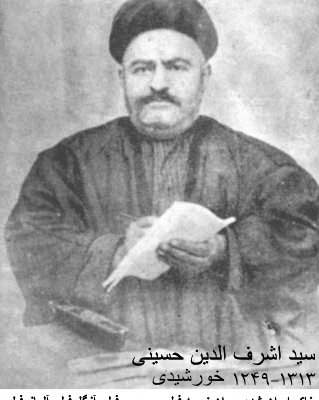
Ashrafoldin Hosseini Gilani Released
He published the first issue of Nasim-e Shomal in the city of Rasht on September 9, 1907, and continued publishing it until a year later, in July 1908, when Mohammad Ali Shah Qajar fired cannon at the Iranian parliament and arrested the constitutionalists. Ashrafedin fled through villages in Gilan and Qazvin provinces to Eshtehard, a city near Tehran, in disguise for fear of arrest after the dissolution of parliament.
Nasim-e Shomal newspaper was not published for seven months.
Some time later, he began a new period of publishing Nasim-e Shomal in the capital and continued his critical writing about political events in Iran until his death. His efforts did not end well for him and he was forced to stop his media work when the Reza Shah came to power in 1925.
Finally, in 1927, it was rumored that he was suffering from psychosis and he was transferred to a mental hospital under the same pretext. Some critics of the government said that Reza Shah's supporters had spread the rumor. Reza Shah was opposed to the political activity of the constitutionalists, and Ashrafedin was one of them.
Ashrafedin spent several years in poverty and illness in a mental hospital, until he died on March 20, 1934, at the age of 64 and was buried in Ibn Babawayh Cemetery.
Hossein Naeemi Zaker, the editor-in-chief of the Shahr-e Farhang newspaper and a close friend of Ashrafedin, quoted Nosratollah Nooh in his book “Memoirs”: “His newspaper caused a stir in the city every day. He was a minimalist man. He had neither fear nor need. Governments were fed up with him. Eventually, he was sent to the madhouse as insane and was chained up. No matter how many times the poor man wrote a letter and pleaded, he was not listened to, and in the end it was not clear why he was destroyed. At the end of March 1934, I was informed by the police that Nasim-e Shomal had died and I was advised not to report the incident in the newspaper. I took the body from the madhouse and took it to Mesgarabad in a cart and buried it without anyone knowing.”
Saeed Nafisi, a well-known Iranian historian and researcher, has also stated in his book “Political, Literary, and Youth Memories”: “They took Hosseini Gilani to Shahre-e no mental hospital, which was known as a madhouse, and placed him somewhere in the back of the hospital. I did not see any sign of madness in this great man. He was the same as always. What was the purpose of this? This is one of the biggest puzzles in the history of our lives.”