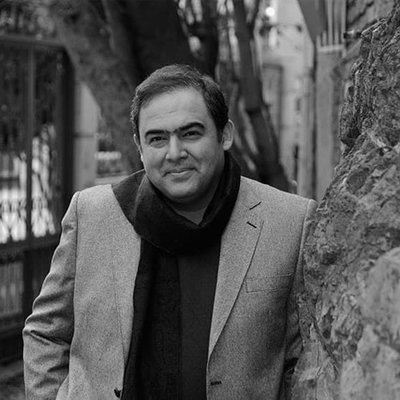
Last Update
Aug. 3, 2021
Organisation
Unknown
Gender
Male
Ethnic Group
Unknown
Religoius Group
Muslim
Province
Tehran
Occupation
Journalist
Sentence
Four months imprisonment
Status
Released
Institution investigating
Unknown
Charges
Propaganda against the regime
Date of Birth
17/6/1971
Hossein Dehbashi Released
First Case
On June 21, 2017, Dehbashi published a memorandum on his Telegram channel, Khesht-e Khaam (Raw Clay), addressed to Ghazizadeh Hashemi, the then Minister of Health of the Islamic Republic, which prompted the Minister of Health to sue him for “disturbing public opinion.”
In this memorandum, he criticized Ghazizadeh Hashemi for the assassination of Morteza Motahhari and dedicated a part of the statement to the financial situation of the Minister of Health. It read: “As some honorable ministers and high-ranking officials of the current government have stated to the esteemed judiciary, some of them have fortunes amounting to 1,000 billion tomans. Hopefully, all their assets, including the wealth of the Minister of Health, are from lawful sources. But we should allow ourselves, out of mathematical curiosity, to question that. Even if during the last 37 years after the Revolution, he, who was usually employed by the government, had a part-time job in the private sector, earning one billion tomans a month, and he did not spend any of it, he should have earned 444 billion tomans by now. Where does the extra 550 billion tomans come from? And if someone asks this question, should they be falsely accused of agreeing with the likes of the extremist Forqan group?”
On December 4, 2017, Dehbashi wrote about the complaint against him on his Telegram channel: “Tomorrow I will have a trial based on Ghazizadeh Hashemi's complaint because I criticized him on this Telegram channel and said his words about the reasons for the assassination of Martyr Motahhari are a distortion of history. It's interesting that the criticism is against him personally and had nothing to do with the Ministry of Health, but the lawsuit is filed by the Ministry!”
The documentary filmmaker announced his sentence of four months imprisonment for this case on December 29, 2017. He wrote in a memo that the branch of the court holding the trial was changed at the last minute before the trial and the verdict was signed by a different judge who had not heard his defense.
After receiving his verdict, Dehbashi, who became one of the critics of Hassan Rouhani's government after the 2013 elections, wrote in a statement that he would not plead with anyone to withdraw their complaint against him.
“The sentence of four months in prison is my atonement for the past cooperation with arrogant politicians who did not hear the broken bones of these oppressed people and regard their honorable patience as the result of their own repressive measures," he wrote.
On January 19, 2018, Dehbashi announced on his Twitter account that the sentence of four months imprisonment had been upheld in the Court of Appeals: “The sentence of four months imprisonment due to a complaint by the government [the Ministry of Health] about disturbing public opinion during the appeal stage has been affirmed and was announced effective.”
The verdict has not been implemented.
In September 2009, Hesamodin Ashna, an adviser to the president, wrote on his Twitter account expressing his opposition to the imprisonment of Hossein Dehbashi, Hossein Ghadyani and Hassan Abbasi: “Prison is no place for journalists, documentary makers, or public speakers, even if their words are inappropriate, unfitting and ill-suited. Answer the media. The law requires them to publish.”
Second Case
Dehbashi received a summons from the Culture and Media Prosecutor's Office on November 3, 2018, and appeared in Branch 4 of the Prosecutor's Office on November 5, 2018.
He was summoned to appear “in defense of the charges brought up in a report by the Ministry of Intelligence against him.”
Dehbashi published a photo of his summons in a memo: “Without any explanation, dated the day after tomorrow. The recipient also does not know what is happening. Friends like you will be very kind if they pray for me in a friendly and fraternal way.
No information has been released on the status of this case.
Third Case
On August 15, 2020, Hossein Dehbashi published a copy of the court notice on his Twitter page that asked him to appear in court on August
He was charged with “propaganda against the regime,” “spreading lies” and “insulting the clergy” on a complaint from the Ministry of Intelligence office in Tehran.
Hassan Dehbashi stated that the reason for his summons was writing a book, “Oral History of Iran.” He wrote on his Twitter page: “My trial tomorrow is for the books of Oral History of Iran and so on. Annoyed? Yes! Angry? Very! Hopeless? One is not hopeless when he has the prophets, imams, saints, and martyrs behind him, and the awesome and fantastic young generation, may God bless their eyes to see the emerging of the twelfth Imam, ahead of him. Do I need your well-meant prayers? Yes, please.”
However, the historian did not explain what he meant by “so on” and why he was charged with three counts for writing a book of history.
The Oral and Visual History of Contemporary Iran is a collection of fifty volumes, seven of which were written by Hossein Dehbashi and published by the National Library of Iran.
On June 27, 2021, Dehbashi announced on Twitter that the Appeals Courts had upheld his sentence for criticizing the lack of quarantine in Qom.
He did not release details of his conviction, but wrote that the case was filed with a joint complaint by the Revolutionary Guards Intelligence Organization, the Ministry of Intelligence, Tehran Deputy Prosecutor, and Qom Prosecutor's Office.
Dehbashi added: "I was condemned for asking why Qom was not quarantined. I didn’t expect so many organizations to file a complaint against me. One would have sufficed!"
In March 2020, at the beginning of the Covid-19 outbreak in Iran, Dehbashi wrote in a tweet: "It is said that history is written by the winners. But I want to write a statement for future observers to testify that the reason for the deathly spread of Covid-19 in 22 provinces of Iran is the selfishness of clerics who forcefully prevented Qom from being quarantined.”
According to the Deputy Minister of Health, the coronavirus first appeared in Iran in the city of Qom through Chinese citizens living in this city. At the time, many on social media had called for a complete quarantine of Qom to contain the spread to other parts of Iran, but this request was opposed by prominent clerics of this religious city.
Professional Record of Hossein Dehbashi
This historian, documentary maker and former media activist is known for making the “Hassan Rouhani” propaganda documentaries in the 2013 presidential election as well as the documentary “According to the Royal Court”.
In 2013, he was Hassan Rouhani's media consultant, but eventually became one of his critics.
In recent years, the filmmaker has created a series called “Khesht-e Khaam” (Raw Clay) which is broadcasted online. In this series, he talks with famous people about different fields of history, which narrates a history of Iran through questions and answers. Dehbashi spoke with political figures such as Faezeh Hashemi Rafsanjani, Seyyed Abolhassan Bani Sadr, Sadegh Zibakalam, Hamid Rasaei, Mostafa Tajzadeh and Ebrahim Yazdi for the project.
Hossein Dehbashi has written and produced many books and documentaries.
Dehbashi has also worked with the Islamic Republic Broadcasting and some Iranian media.